Guide
Nail guns and a small crew
Choose the trigger that halves the injury risk, set the work habits that keep nails out of hands and legs, and train every new hire on the actual tool.
Satisfy+ Editorial · Published June 9, 2026 · 4 min read
At a glance
- Emergency room visits
- About 37,000 a year (2011)
- Safest trigger
- Full sequential
- Contact trigger risk
- About twice that of a sequential trigger
- Most injured
- Hands and fingers
As of 2011, nail guns caused an estimated 37,000 emergency room visits a year. About two-thirds of the injuries happen in framing and sheathing work.
In one study of apprentice carpenters, 2 out of 5 were injured with a nail gun during their 4 years of training. More than half of the injuries are to the hand and fingers, and a quarter of those damage tendons, joints, nerves or bone. Many go unreported and untreated. The trigger on the tool and the training behind it make the biggest difference.
The trigger
Every nail gun has two controls: a finger trigger and a contact safety tip on the nose. The order they must be pressed in sets the trigger type.
A full sequential trigger fires only when the tip is pushed in first and the trigger is squeezed second. Both must be released before the next nail. It can't bump fire, and it's the safest kind.
A contact trigger fires when both are pressed, in any order. Held squeezed, it drives a nail each time the tip touches something. That can be a leg on the way down a ladder, or a co-worker walking past.
The overall risk of a nail gun injury is about twice as high with a contact trigger as with a sequential one. Training doesn't close the gap. Trained workers using contact triggers still have twice the risk of trained workers using sequential ones.
Some sequential triggers sold on framing nailers aren't full sequential, so check the label and the manual. A manufacturer or supplier can sell you a full sequential trigger kit. In the one study comparing the two, framers nailed 10 percent faster with a contact trigger. That came to less than 1 percent of the total building time.
How the injuries happen
- A double fire, when a contact trigger nailer recoils and fires a second nail faster than you can let go
- Knocking the tip with the trigger held, while carrying the gun with a finger on the trigger
- Lumber that a nail passes through into the hand holding the piece, often near a knot
- Ricochets off a knot, metal hardware or a dense beam
- A nail flying free when the tip misses the edge of a plate or a stud behind sheathing
- Awkward nailing: toe-nailing, overhead, in tight spaces, from a ladder or toward yourself
- A bypassed safety, such as a removed spring or a taped-down trigger
About 1 in 10 nail gun injuries happens to a co-worker, from a flying nail or a bumped tip.
Work habits that prevent them
Use full sequential nailers at least for placement work, where one hand holds the lumber, such as building walls, nailing blocking and setting trusses. Start new hires on full sequential nailers too.
- Keep hands at least 12 inches from the nailing point, and use clamps where you can.
- Check the lumber for knots, nails and straps first, and use a hammer on metal hardware.
- Shoot away from your body and away from the crew.
- Disconnect the air before leaving a nailer, climbing a ladder or stairs, handing it to someone, or clearing a jam.
- Don't lower a nailer from above or drag it by its hose.
- Use the nailer in your dominant hand only.
Training covers how the triggers differ, the causes of injury, the tool manual, and hands-on practice with the nailers the crew will use. Workers using nail guns wear safety glasses or goggles marked ANSI Z87.1, hearing protection and a hard hat.
Reporting injuries
Ask the crew to report every nail gun injury and close call, so the injured worker gets medical care and the cause gets fixed. Make sure a safety incentive program doesn't discourage anyone from reporting.
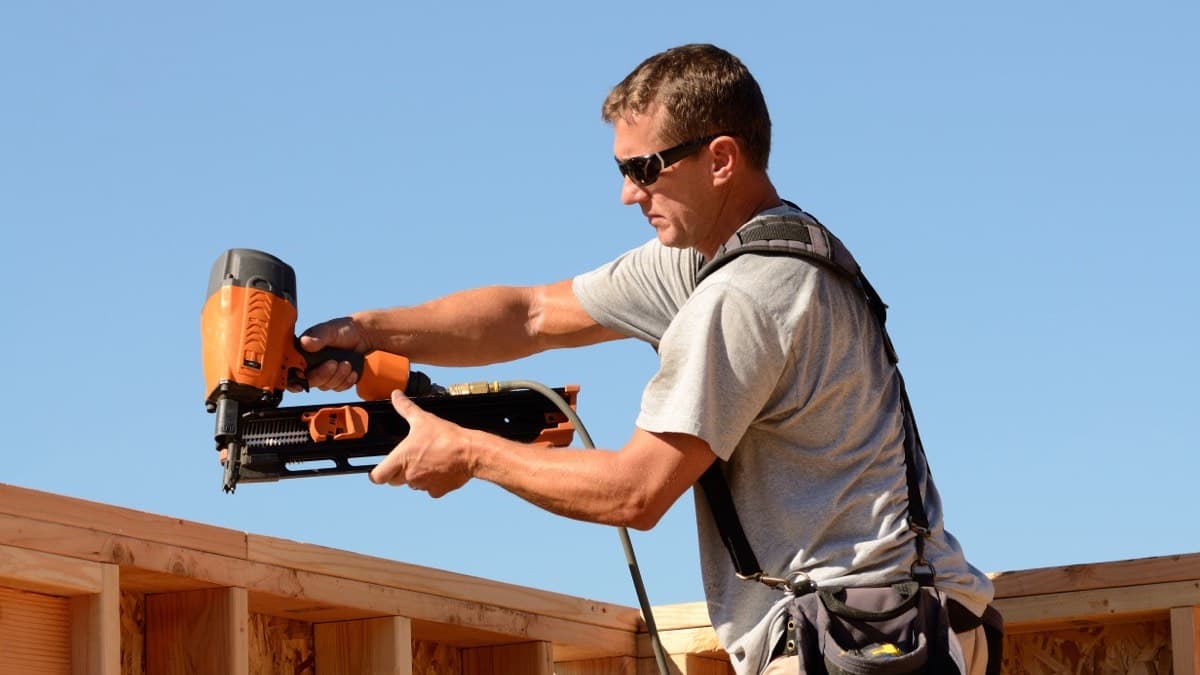
An annotated example
What to do next
Read the trigger type on every nail gun the crew uses, and switch the framing nailers to full sequential. Color-code the tools so anyone can tell the triggers apart, and give each new hire hands-on training before their first day of nailing.
Make the crew's nail guns safer
- Check the trigger type on every nail gun
- Order full sequential trigger kits for the framing nailers
- Run hands-on nail gun training for each new hire
FAQ
Which nail gun trigger is safest?
The full sequential trigger. It fires only when the tip is pressed first, and it can't bump fire.
Does a sequential trigger slow the crew down?
In one study, framers nailed 10 percent faster with a contact trigger, which was less than 1 percent of the total building time.
How far should my hand be from the nail?
At least 12 inches. Use a clamp to hold the piece where you can.
Sources
Checked October 20, 2026
- National Institute for Occupational Safety and Health. Nail gun safety: a guide for construction contractors (2011)
- $100 to $1,000
- Professional