Guide
Window air conditioners, sizing, sealing and storing them
Measure the room to find the size of window air conditioner it needs, have the unit fitted level and sealed, and take it out or cover it for winter.
Satisfy+ Editorial · Published May 6, 2026 · 3 min read
At a glance
- 100 to 150 sq ft
- 5,000 BTUs
- 250 to 300 sq ft
- 7,000 BTUs
- 450 to 550 sq ft
- 12,000 BTUs
- Thermostat
- 78°F, or as high as is comfortable
A window air conditioner that's too big for the room costs more and uses more power without cooling any better. It also cools the air so fast that it doesn't have time to pull out the humidity, so the room ends up cold and clammy. Size it to the room's floor area.
Measure the room
Measure the length and width in feet, turning inches into fractions of a foot, so 12 feet 6 inches is 12.5 feet. Multiply the two to get the square footage. For an L-shaped or odd room, split it into rectangles and triangles and add them up. A triangle is the length times the width, divided by two.
Find the size
These capacities assume an 8-foot ceiling:
| Area to be cooled | Capacity needed |
|---|---|
| 100 up to 150 sq ft | 5,000 BTUs |
| 150 up to 250 sq ft | 6,000 BTUs |
| 250 up to 300 sq ft | 7,000 BTUs |
| 300 up to 350 sq ft | 8,000 BTUs |
| 350 up to 400 sq ft | 9,000 BTUs |
| 400 up to 450 sq ft | 10,000 BTUs |
| 450 up to 550 sq ft | 12,000 BTUs |
| 550 up to 700 sq ft | 14,000 BTUs |
| 700 up to 1,000 sq ft | 18,000 BTUs |
Then adjust for the room:
- A heavily shaded room. Take off 10 percent.
- A very sunny room. Add 10 percent.
- More than two people. Add 600 BTUs for each person past two who uses the room regularly.
- A kitchen. Add 4,000 BTUs.
- A unit near a corner. Choose one that can aim its air toward the room.
Fitting it
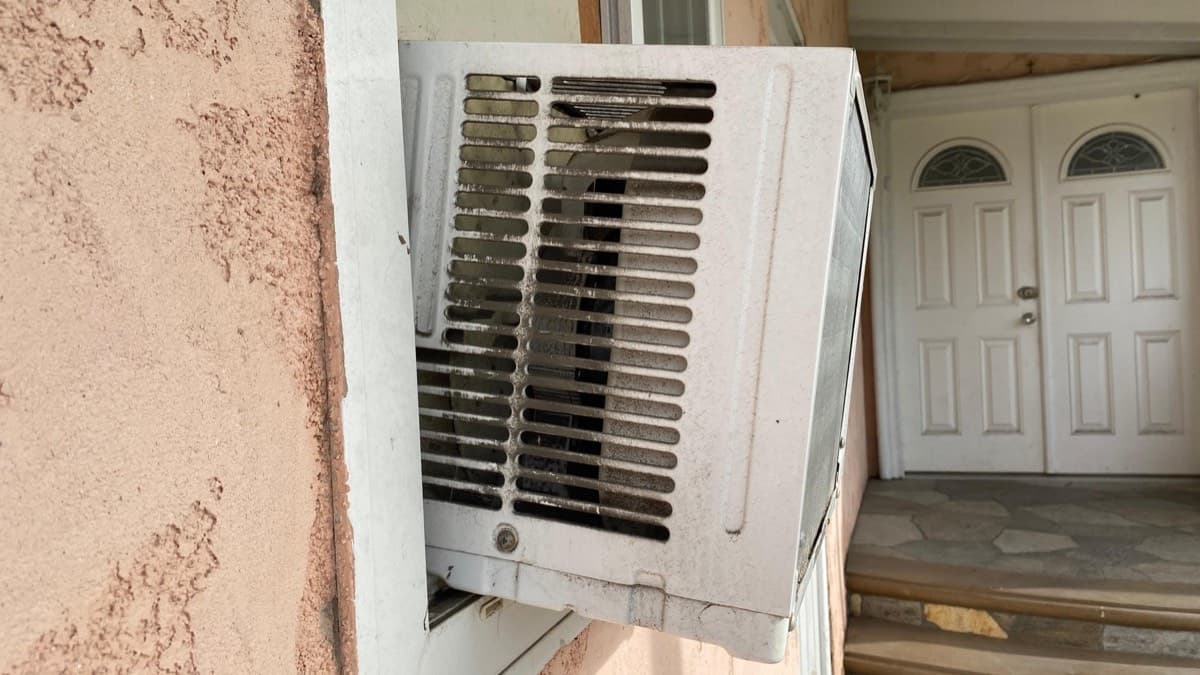
A badly fitted unit can leak as much air as a 6-square-inch hole. Have it put in following the unit's instructions, using the foam panels and insulation that come in the box. It has to sit level so the condensation drains properly.
Plug it straight into a wall outlet. An extension cord isn't as safe as the house wiring and isn't meant for permanent use.
Running it
- Set the thermostat as high as is comfortable. 78°F is a common setting.
- On humid days, run the fan on low. Slower air pulls out more moisture.
- Keep lamps and TVs away from the unit. Their heat reaches the unit's thermostat, so it runs longer.
- A ceiling or floor fan spreads the cool air further.
Winter
At the end of the summer, have the unit taken out if you can, since the gaps around it let heat escape all winter. If it has to stay in, put a cover on the outside that fits it.
An annotated example
What to do next
Measure each room that will get a unit and note the BTUs from the chart. Ceiling fan direction and settings by season covers setting the fan that helps it.
Set up the window air conditioner
- Measure the room and look up the BTUs it needs
- Check the window unit is level with its insulation in
- Have the window unit taken out, or cover it, for winter
FAQ
What size window air conditioner do I need?
It depends on the room's floor area. A 100 to 150 square foot room needs about 5,000 BTUs, and a 450 to 550 square foot room about 12,000. Add 10 percent for a sunny room and take off 10 percent for a shaded one.
Is a bigger air conditioner better?
No. An oversized unit uses more power, doesn't cool better, and leaves the room damp and clammy.
Sources
Checked October 19, 2026
- ENERGY STAR. Room air conditioners (2026)
- U.S. Consumer Product Safety Commission. Home electrical safety checklist (Publication 513) (2008)
- HVAC
- Owner
- Summer
- Tenant