Checklist
A breakdown on the highway, and the first five minutes
Get the car off the travel lanes, stay inside if you're clear of traffic, and call for help with a mile marker if your car breaks down on the highway.
Satisfy+ Editorial · Published September 3, 2026 · 3 min read
At a glance
- Pull over
- Far right shoulder, as far off the road as you can
- Stay inside
- If the car is clear of traffic
- Call
- For help, with a mile marker or exit number
- Get out
- If you can't get clear of traffic
If your car breaks down on a highway and you can get it away from traffic, the safest place to wait is usually inside it. Getting out to look at the problem puts you beside traffic moving at highway speed.
Getting off the road
- Turn on the hazard lightsDo this first, so drivers behind you know the car is slowing or stopped. Leave them on the whole time you wait, especially at night or in bad weather.
- Pull onto the far right shoulderGet as far off the road as you can while staying on level ground. On a divided highway with a median, the left shoulder is an option too.
- Let the car coastIf the engine stops or you run out of gas, steer out of traffic and let the car's momentum carry it off the road. Brake only when you need to.
- Don't push a car that won't moveIf it loses power in a lane, leave the hazards on and don't try to push it.
Staying with the car
- Stay inside if you're clear of trafficWait in the car until the police or a road service truck arrives. Keep the windows almost closed and the doors locked.
- Don't get out to lookNever get out to repair or examine the car on a busy highway. Move it somewhere safer first, even on a flat tire.
- Get out if you can't get clearIf the car is still near traffic, or you think it may be hit from behind, don't stay in it. Leave by the side away from the road, and wait well away from the car and the traffic.
- Never stand behind or in front of the carOther drivers may not see you there.
- Don't idle for long to heat or cool the carRunning the engine for a long time while you wait risks carbon monoxide poisoning.
Letting other drivers see you
- Raise the hoodTie a bright scarf or cloth to the antenna or a door handle, or shut it in a window.
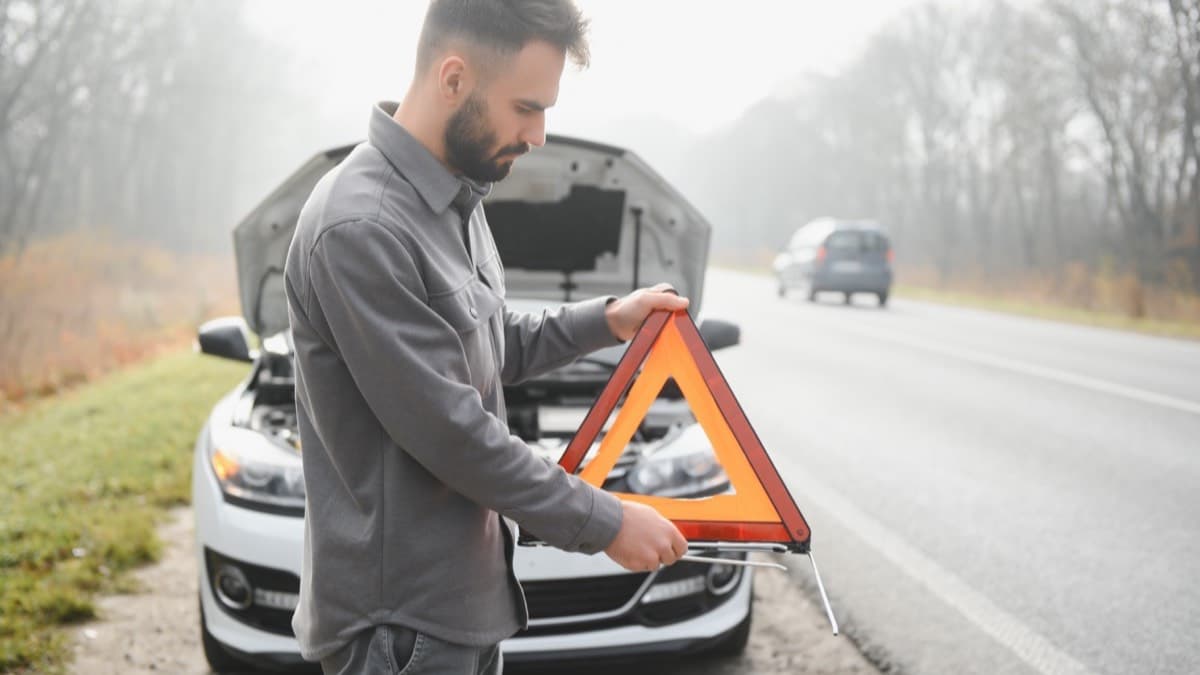
- Set out flares or warning trianglesPut the first one 10 feet behind the car on the side closest to the road, and the second 100 feet behind the middle of the bumper. Never light a flare if you smell fuel.
Calling for help
- Call from inside the car, if you're clear of trafficOtherwise, call from a safe distance away from the car and the road.
- Say where you areOn an interstate, give the mile marker, the last exit number or the nearest call box or rest area.
- Have the details readyYour insurance or roadside plan's details, a phone number to reach you, the car's color, make, model and year, and the license plate.
- Have your insurer's or roadside plan's numberFor what an auto policy can pay toward a tow, see Towing and rental reimbursement on an auto policy.
Before it happens
- Keep a few things in the carA phone and charger, a flashlight with extra batteries, a reflective vest, flares or warning triangles, jumper cables, a first-aid kit, a blanket, water and food that keeps.
- Add the cold-weather extras for winterSee The winter car kit.
Get the car ready for a breakdown
- Save your insurer's roadside number in your phone
- Put a reflective vest and a first-aid kit in the car
- Put flares or warning triangles in the trunk
- Keep a phone charger and a flashlight in the car
Sources
Checked October 20, 2026
- AAA. What to do when your vehicle breaks down: the AAA guide to personal safety (2010)
- Insurance Information Institute (insurer-funded). Car breakdown safety (2026)
- Car