Explainer
Why ice dams form and how to stop them
Learn how heat escaping into the attic melts roof snow into a ridge of ice at the eaves, and which attic fixes keep the roof cold enough to stop it.
Satisfy+ Editorial · Published October 7, 2026 · 2 min read
At a glance
- The cause
- Heat from the house warming the roof under the snow
- Where it forms
- The eaves, valleys and around chimneys
- The damage
- Meltwater backs up under the shingles and leaks inside
- The fix
- Seal the attic air leaks, then insulate and ventilate
An ice dam starts when snow covers a roof and the roof deck under it rises above freezing. Heat escaping from the house usually warms it. The snow touching the deck melts and runs down to the eaves, where the overhang is colder, and it freezes again. As the cycle repeats, the ice builds into a ridge that holds back more meltwater. That water backs up under the shingles and leaks into the attic and the walls.
Why some roofs get them
Ice dams need lasting snow and long stretches below freezing, so they're most common in cold, snowy climates. Snow itself insulates, at roughly R-1 to R-2 an inch, so a deep snowfall traps more heat against the roof. Complicated roofs, with several levels, valleys and dormers, are harder to seal and insulate. They get ice dams more easily than a simple roof over a vented attic.
What stops them
The goal is a roof deck that stays as cold as the air outside. The work happens in the attic, and it's work to have done by a professional.
- Seal the air leaks into the attic. This is the most important step. Warm air leaking up from the house is one of the biggest sources of ice dams.
- Insulate the attic floor. In the coldest climate zones, a vented attic needs R-60 or more, carried out over the tops of the outside walls.
- Ventilate the attic, with air flowing in at the soffits and out at the ridge. Baffles keep the insulation out of the soffit vents and leave at least 2 inches of air space under the roof deck.
- Keep heat sources out of the attic. A furnace or ducts in the attic warm the roof deck from below.
In snowy country, a new roof usually gets a self-adhering waterproof membrane at the eaves and in the valleys. It protects against the water that does back up.
An annotated example
What to do next
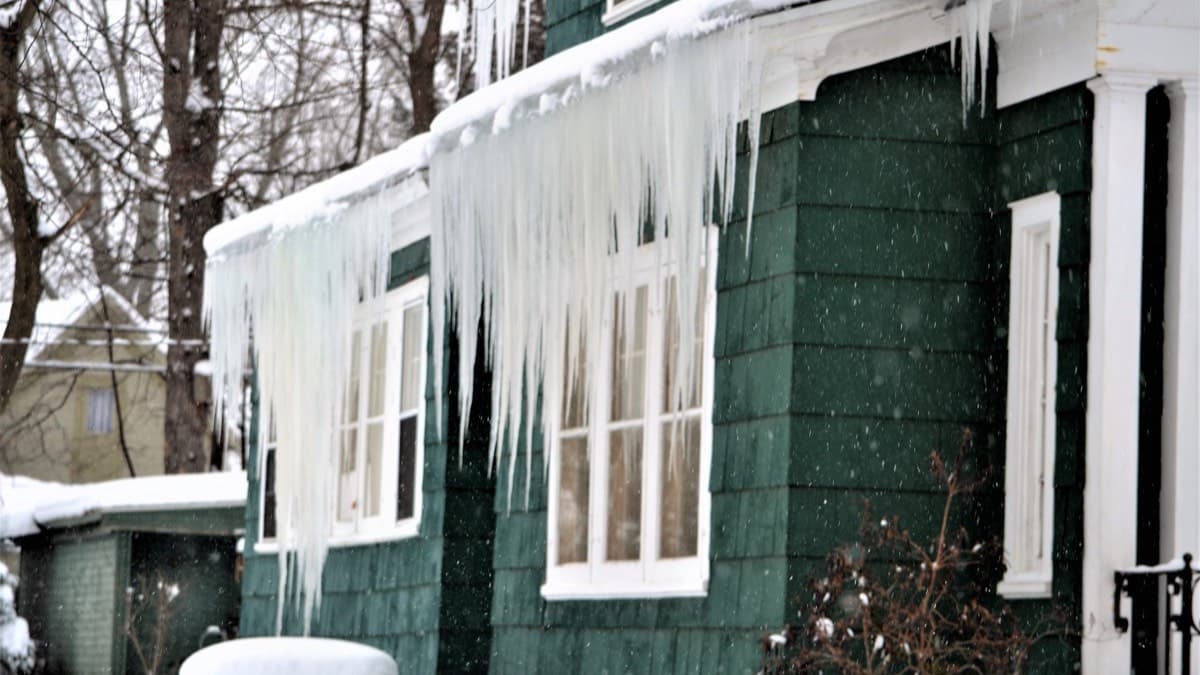
After a snowfall, look along the eaves for a thick ridge of ice and long icicles. Check the ceilings and walls under the roof for stains too. Have any ice on the roof removed by a roofer rather than climbing up yourself. Then book an assessment of the attic's air sealing, insulation and ventilation before next winter.
Keep ice dams off the roof
- Check the eaves for ridges of ice after a snowfall
- Check the attic ceiling and top-floor walls for water stains
- Book an attic air sealing and insulation assessment
FAQ
What causes ice dams?
Heat escaping from the house warms the roof under the snow. The meltwater runs to the cold eaves and refreezes.
Does more attic ventilation fix ice dams?
It helps, but sealing the air leaks into the attic matters most, followed by insulation.
Should I chip ice off the roof myself?
No. Have a roofer remove it.
Sources
Checked October 19, 2026
- U.S. Department of Energy, Building America Solution Center. Construct roofs and attics for ice dam prevention (2026)
- Cold
- Hire
- Owner
- Winter storm
- Winter
- Insulation
- Roof