How-to
Grubs in the lawn, checking before you treat
Dig up a square foot of turf at the edge of a dying patch, count the grubs, and treat only where the count is over the threshold for that kind of grub.
Satisfy+ Editorial · Published June 10, 2026 · 3 min read · 30 min to do · Free
At a glance
- What they are
- The larvae of June beetles, Japanese beetles and other scarab beetles
- Signs
- Brown patches that peel back like a carpet
- Check
- Dig and count a square foot
- Needed treatment
- About 20% of the time, in New York research
White grubs are the larvae of scarab beetles, including May and June beetles, Japanese beetles, European chafers and Asiatic garden beetles. They live in the soil and eat grass roots, so you may not know they're there until the lawn starts to die. Damage looks like drought, with thin, yellowing turf and irregular dead patches. Skunks, raccoons, crows and armadillos digging for grubs can do more harm than the grubs themselves.
Salt or soapy water won't bring grubs to the surface. The only way to know how many you have is to dig. In upstate New York research, home lawns needed an insecticide treatment only about 20% of the time.
What you need
- A flat shovel or a bulb planter
- A ruler or tape measure
Steps
- 1
Pick the spots
Start at the edges of brown or dying patches, where the grubs are still feeding. Add a few spots in the parts of the lawn you care most about.
5 min
- 2
Pull on the grass
Heavily damaged turf feels spongy underfoot and peels back like a carpet, because the roots have been chewed away.
2 min
- 3
Cut and peel back a square foot
Cut three sides of a 1-foot square with the shovel and fold the turf back.
10 min
- 4
Count the grubs
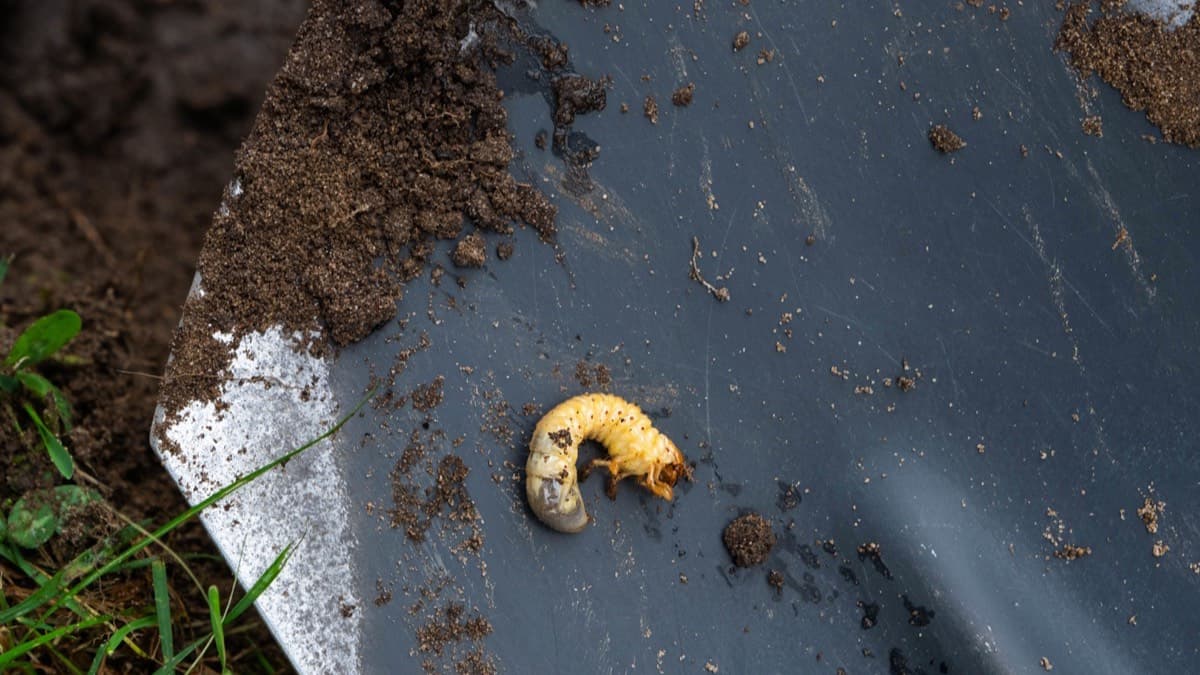
Look through the roots and the top few inches of soil. Grubs are white and soft, with a brown head and six legs, and lie curled in a C shape.
5 min
- 5
Press the turf back down and water it
Fold the square back into place and soak it.
3 min
- 6
Repeat in the other spots
One high count can be a fluke. Several spots at or above the threshold mean the lawn has a problem.
10 min
- 7
Check each count against the threshold
As a general rule, damage shows above 5 to 10 grubs per square foot. Thresholds differ by kind of grub.
2 min
Count the grubs before treating
- Dig up a square foot of lawn and count the grubs
- Water and reseed the patches the grubs thinned
How many is too many
Big grubs eat more roots, so fewer of them do the same damage.
| Grub | Grubs per square foot before damage shows |
|---|---|
| May or June beetle | 3 to 4 |
| European chafer | 5 to 8 |
| Japanese beetle | 8 to 10 |
| Oriental beetle | 8 |
| Northern masked chafer | 8 to 12 |
| Asiatic garden beetle | 18 to 20 |
A healthy lawn with a deep root system can take more grubs than these numbers. Grass stressed by heat, drought or too much water shows damage at lower counts. Your county extension office can identify the grub if you're not sure which kind you have.
If the count is over the threshold
Treat only the areas over the threshold, or the areas with a history of grub damage. Timing matters as much as the product.
- Before the grubs hatch. Preventive insecticides go down in late spring or early summer, before the new generation starts feeding. They make sense mainly on a lawn with a history of grub damage.
- Small grubs in late summer. Young grubs are easier to kill and haven't done much damage yet. In New York this is usually August. In South Texas it's June, and in North Texas early July.
- Big grubs in fall. By October it's too late to treat that year's grubs.
Water a dry lawn about a day before a treatment, and water it in after, so the product soaks down to the roots. Follow the label on any insecticide.
Helping the lawn recover
Water the damaged areas regularly, fertilize in the fall and reseed the bare patches. Grubs stop feeding as they get ready to pupate in late spring, so seed sown by the end of May can grow without them.
FAQ
How do I know if I have grubs in my lawn?
Dig up a square foot of turf at the edge of a dying patch and count the white, C-shaped grubs in it.
How many grubs per square foot is too many?
Usually more than 5 to 10. For large May or June beetle grubs it's 3 to 4, and for small Asiatic garden beetle grubs it's 18 to 20.
When is it too late to treat for grubs?
By October the grubs are large and nearly done feeding, so treating that year's grubs doesn't help. Focus on watering, fall fertilizing and reseeding.
Sources
Checked October 20, 2026
- Cornell University, New York State Integrated Pest Management. White grubs (2024)
- University of Maine Cooperative Extension. White grubs (2024)
- Texas A&M AgriLife Extension. White grub identification and control (SCSC-PU-155) (2015)
- Yard
- Owner
- Pests
- Summer
- Beginner
- Free
- DIY