How-to
Thatch, checking for it and when to dethatch
Cut a wedge of sod to measure the spongy layer above the soil, and dethatch or core aerate only when it's over half an inch, when your grass recovers fastest.
Satisfy+ Editorial · Updated August 1, 2026 · 3 min read · 15 min to do · Free
At a glance
- What it is
- Dead and living stems and roots above the soil
- Fine
- Up to 1/2 inch
- Too much
- Over 1/2 inch
- Cool-season lawns
- Dethatch in late summer or early fall
Thatch is a spongy layer of living and dead stems, roots and runners that builds up between the soil and the green grass blades. It forms when grass produces these parts faster than they break down. A thin layer, up to half an inch, cushions the lawn and holds moisture. More than that dries out fast and is hard to rewet, harbors disease and insects, and slows air, water and nutrients getting into the soil. Roots grow up into the thatch instead of the soil, so the grass can die in large patches in summer heat and drought.
Grass clippings don't cause thatch. They're mostly water and break down quickly on a lawn mowed regularly. Kentucky bluegrass, bermudagrass and zoysiagrass build thatch fastest. Tall fescue and perennial ryegrass build little.
What you need
- A spade or a sharp knife
- A ruler
Steps
- 1
Pick a few spots
Check the lawn even if it looks healthy. Thatch can build up for years before it shows.
2 min
- 2
Cut out a wedge
Cut a pie-shaped wedge of sod 2 to 3 inches deep with the spade, and lift it out.
5 min
- 3
Find the layer
Thatch shows as a distinct brown band of spongy or feltlike material between the green blades and the soil.
2 min
- 4
Measure it
Hold the ruler against the side of the wedge and measure from the soil surface to the base of the green growth.
2 min
- 5
Put the wedge back and water it
Press it firmly into place.
2 min
- 6
Check the measurement against half an inch
Up to 1/2 inch is fine. Over 1/2 inch needs dethatching or core aeration.
2 min
Check the lawn for thatch
- Cut a wedge of sod and measure the thatch layer
- Plan a core aeration if the thatch is over half an inch
When to dethatch
Dethatch only when the grass can recover quickly, and avoid hot, dry spells.
- Cool-season lawns. Late summer or early fall. In the Midwest, late August gives the best recovery and time to reseed.
- Warm-season lawns. Spring after green-up, or early summer while the grass is growing fast. Mid-June suits zoysiagrass and bermudagrass that are actively growing.
Dethatching or core aeration
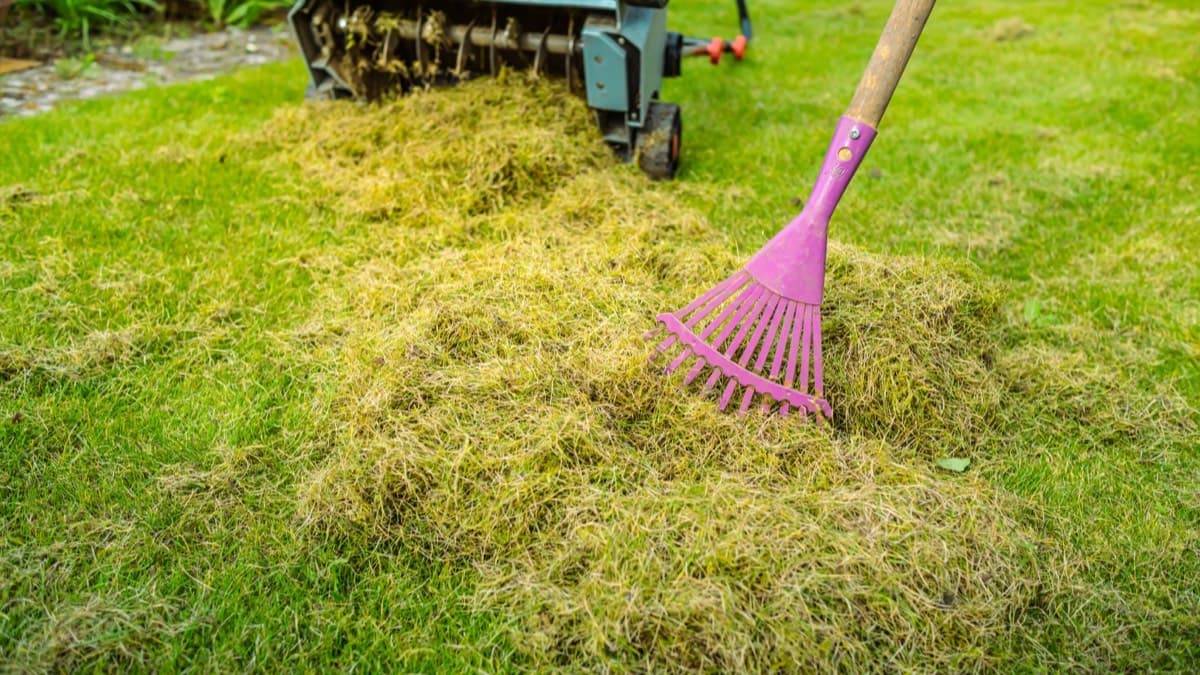
- A dethatching rake. It handles small areas. Its curved blades slide through the thatch and lift it out as you pull.
- A power rake or vertical mower. Needed for large areas. It's hard on the lawn, because the roots are in the thatch and pull out easily, and the lawn usually needs overseeding after. Improper dethatching can ruin a lawn, so a lawn care company is an option for this one.
- Core aeration. Causes much less stress than power raking and also relieves compaction. Leave the soil cores on the surface to dry and crumble, which spreads the microbes that break thatch down. Two passes, the second at right angles to the first, give about 15 to 20 holes per square foot.
Rake up and remove the loose thatch after dethatching, then water the lawn well so the exposed roots don't dry out. A zoysia lawn with an inch or more of thatch may do better with moderate treatment over two or three years than with one heavy pass.
Keeping thatch down
- Don't overdo nitrogen or water. Both make grass grow faster than it decomposes.
- Mow regularly. Take no more than a third of the blade at a time, and leave the clippings.
- Keep the pH right. Acidic soil slows the earthworms and microbes that break thatch down. Heavy, wet, compacted and high-pH soils also favor thatch.
- Topdress after aerating. A thin layer of topsoil or compost, 1/8 to 1/4 inch, adds microbes that help break down the thatch.
FAQ
How do I know if my lawn has too much thatch?
Cut a wedge of sod 2 to 3 inches deep and measure the brown, spongy layer above the soil. More than half an inch is too much.
Do grass clippings cause thatch?
No. Clippings break down quickly on a lawn mowed regularly. Thatch is mostly stems, roots and runners.
When should I dethatch my lawn?
Late summer or early fall for cool-season grasses, and late spring to early summer for warm-season grasses once they're growing actively.
Sources
Checked October 20, 2026
- Clemson Cooperative Extension, Home and Garden Information Center. Controlling thatch in lawns (HGIC 2360) (2018)
- University of Missouri Extension. Managing thatch in home lawns (G6708) (2025)
- University of Illinois Extension. Managing thatch in home lawns (2024)
- Yard
- Owner
- Beginner
- Free
- DIY