How-to
Cleaning and finishing a wood deck
Clean off the mildew without power washing, let the boards dry, and put on a penetrating finish before the wood cracks and checks.
Satisfy+ Editorial · Published April 30, 2026 · 3 min read · 5.5 hr to do · $100 to $1,000
At a glance
- Finish
- Penetrating, not paint or solid stain
- Water-repellent preservative
- Lasts about a year on the deck boards
- Cleaning
- Bleach, 1 part to 3 parts water, no ammonia
- Before finishing
- At least 2 warm, windy days to dry
Sun and rain make a wood deck swell and shrink all year. Left unfinished, the boards develop checks and cracks, raised grain and mildew, and those raise the risk of rot and insects. Most decks are torn out because of cracks and checks that timely finishing could mostly have prevented. Deck lumber is usually pressure-treated, or a naturally durable wood such as redwood or western redcedar. A finish on top of either cuts down on the cracking and mildew.
A pressure-treated deck built before 2004 that isn't cedar or redwood is most likely CCA-treated wood. Skip the bleach, the scrubbing and the power washer on it, and don't sand it.
What you need
- A stiff brush on a pole, a bucket and a garden hose
- Household bleach and a powdered detergent without ammonia, or a deck cleaner
- A penetrating finish: water-repellent preservative, a colored water-repellent preservative or a semitransparent stain
- A brush, a pad or a roller for the finish
Steps
- 1
Mix the cleaner
Mix 1 part liquid household bleach with 3 parts water and add some powdered detergent. Use more water if you're working alone or slowly. Never use a liquid detergent or one that contains ammonia, which reacts with bleach to make a toxic gas.
5 min
- 2
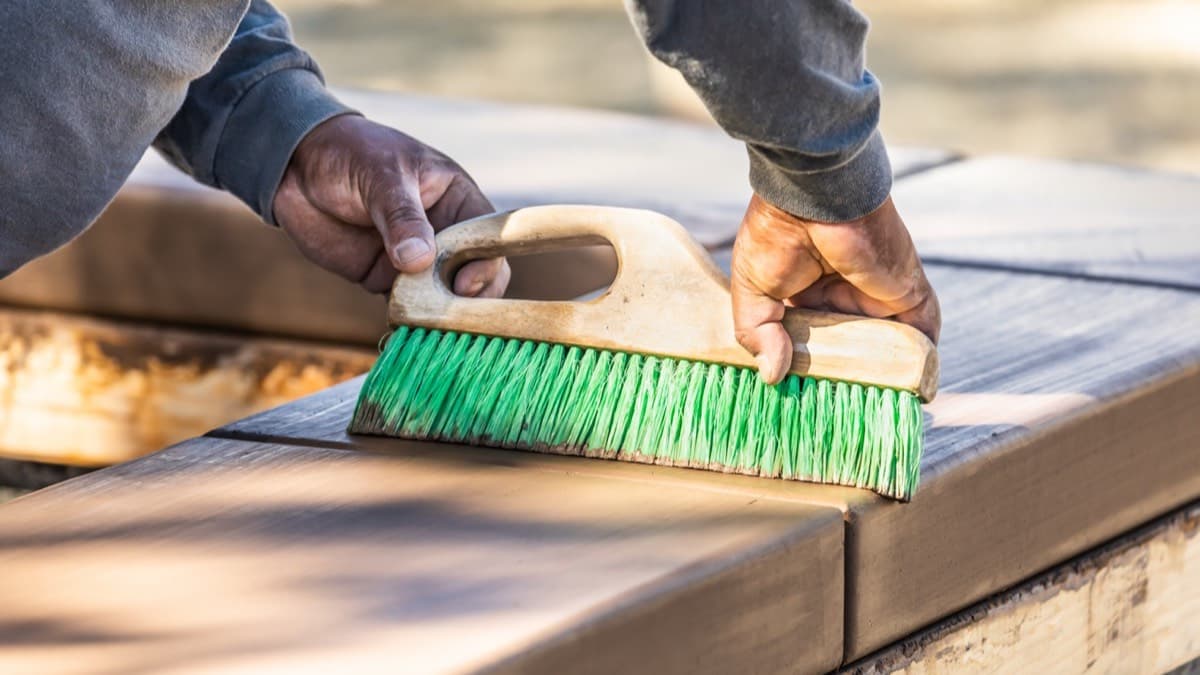
Scrub off the mildew and dirt
Brush the solution over the boards to lift the mildew and dirt. Skip aggressive scrubbing with a caustic cleaner, and skip the power washer. Both can strip wood off the surface, especially on a softer wood like western redcedar. A gray surface that won't scrub off is fine to leave, since it soaks up stain well.
90 min
- 3
Rinse the deck
Rinse the solution off the deck with plenty of water.
30 min
- 4
Let it dry
Give the deck at least 2 warm, windy days before you finish it.
5 min
- 5
Put on a penetrating finish
Brush or roll a water-repellent preservative or a semitransparent stain onto the boards. Coat the ends of any boards cut during building too, since they soak up water through the end grain.
180 min
- 6
Check a stained deck for stripes
Look along the boards once the finish dries. Darker stripes are lap marks, where fresh stain overlapped an area already finished and left two coats. A water-repellent preservative has no pigment, so it doesn't show them.
20 min
Keep the wood deck finished
- Clean the deck and let it dry for two warm days
- Put a water-repellent preservative on the deck
Choosing the finish
Paint and solid-color stain form a film on top of the wood. On a deck, that film wears through quickly where people walk, and it traps moisture and peels as the boards swell and shrink. A penetrating finish soaks in instead, holds up better, and is easier to put back on.
- Water-repellent preservative is the easiest finish to reapply, and it soaks well into the end grain. On the exposed deck boards it lasts about a year. Pick one with a mildewcide, since a plain water repellent often leaves blotchy staining.
- Colored water-repellent preservative adds a little pigment, which lets the grain show and lasts many years where foot traffic is light.
- Semitransparent oil-based stain has much more pigment and lasts longer still. It soaks in without forming a layer, so it won't blister or peel. It's the second-easiest finish to put on.
If you're not sure which to use, start with a water-repellent preservative. You can switch to a semitransparent stain at the next refinishing. Paint and solid-color stain work well on railings, which don't take the wear of the deck boards.
New lumber
A deck built with a factory water-repellent finish, or one recently treated with a water-repellent preservative, may not take a semitransparent stain well right away. Let the wood weather for 2 to 3 months first. Waiting up to a year opens the wood to take more finish, but the boards can check badly in the meantime.
FAQ
How often should I seal a wood deck?
A water-repellent preservative lasts about a year on the deck boards. A semitransparent stain lasts longer.
Can I power wash a wood deck?
It can strip wood from the surface, especially on softer woods like western redcedar. Scrub with a bleach and water solution instead and rinse well.
Should I paint my deck?
Not the boards. Paint and solid-color stain wear through and peel on a deck. Use a penetrating finish, and keep paint for the railings.
Sources
Checked October 20, 2026
- USDA Forest Service, Forest Products Laboratory. Finishes for wood decks (2013)
- U.S. Consumer Product Safety Commission. CCA-pressure treated wood: guidance for outdoor wooden structures (Publication 270) (2011)
- Exterior
- $100 to $1,000
- Owner
- Spring
- Beginner
- DIY