How-to
Watering a vegetable garden with drip lines and soaker hoses
Fit a backflow preventer, filter and pressure regulator at the faucet, lay lines 12 inches apart under mulch, and water when the top few inches are dry.
Satisfy+ Editorial · Published September 28, 2026 · 3 min read · 1.5 hr to do · Under $100
At a glance
- At the faucet
- Backflow preventer, filter, then pressure regulator
- Line spacing
- 12 inches apart in a bed
- Soaker hose runs
- 25 feet or less
- Water when
- The top 2 to 4 inches are dry
Drip lines and soaker hoses put water on the soil at the roots instead of on the leaves. Drip irrigation is over 90 percent efficient, against 50 to 70 percent for sprinklers, and it keeps the soil evenly moist. Dry leaves also matter in a vegetable garden. Overhead watering splashes disease onto tomatoes, peppers and potatoes and gives early blight the wet leaves it needs.
Drip line or soaker hose
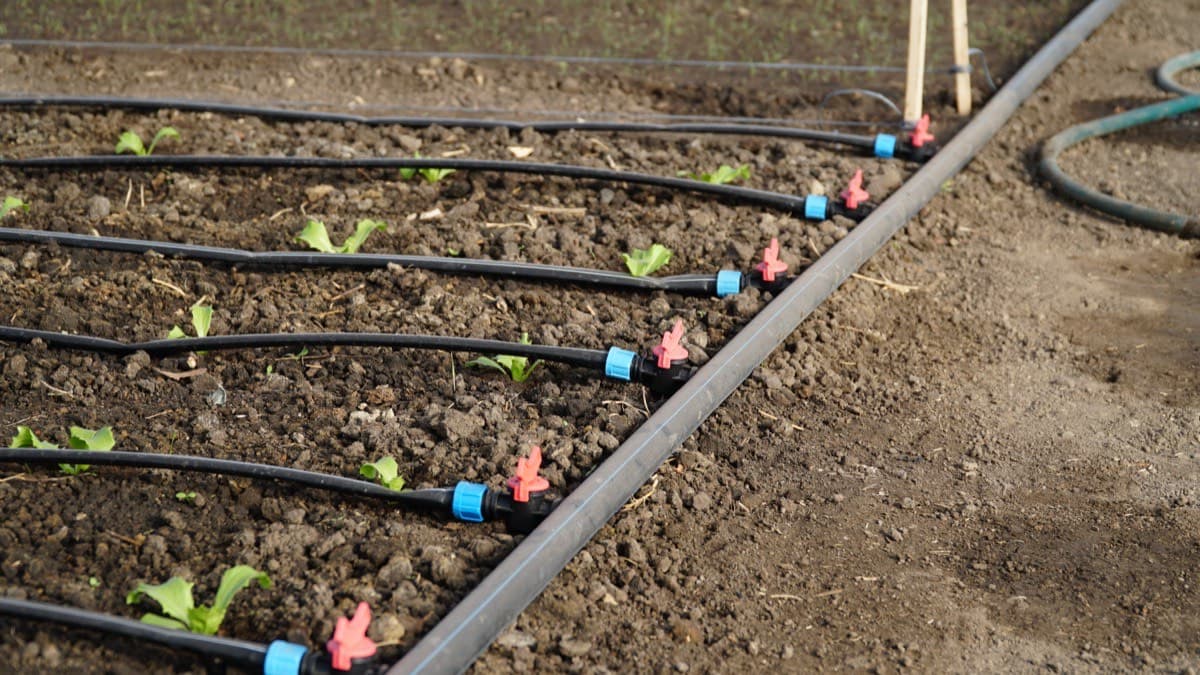
- In-line drip tubing has emitters built in every 6, 12 or 24 inches. It waters evenly along its length, but needs clean water, so it suits a municipal supply better than rain barrel or gray water.
- Half-inch soaker hose seeps water along its whole length. It tolerates a little dirt or algae better, but the flow varies along the hose, more at the start than the end.
What you need
- Drip tubing or soaker hose
- A backflow preventer, a filter and a pressure regulator with hose fittings
- A hose-end timer, if you want it automatic
- Wire stakes
- End caps or plugs
Steps
- 1
Assemble the head at the faucet
Put them on in this order from the faucet: a backflow preventer, then a filter, then a pressure regulator. The backflow preventer keeps garden water from being siphoned back into the household supply. A 150 to 200 mesh filter suits municipal water.
10 min
- 2
Lay out the lines
Run them 12 inches apart, so a 4-foot bed gets four runs up and down. For widely spaced crops like corn, squash and cabbage, three runs across a 4-foot bed is enough. A 2-foot bed of tomatoes or beans needs one line down and back.
20 min
- 3
Keep soaker runs short
Keep each soaker hose to 25 feet or less, on level ground. On a slope, use several short runs.
5 min
- 4
Pin and cover them
Hold the lines in place with wire stakes every 2 to 3 feet, and cover them with mulch. A soaker hose can also go 2 inches into the soil to protect it from sunlight.
20 min
- 5
Cap the ends
Close the end of each line with a cap or plug you can open later to flush out sediment.
5 min
- 6
Run it and time it
With a pressure regulator on a soaker hose, 10 to 20 minutes usually waters a garden. Check the soil afterward and adjust. More water is needed in midsummer heat than in spring and fall.
20 min
- 7
Check the soil before the next watering
Dig down with a trowel. Water again when the top 2 to 4 inches are dry to the touch.
2 min
Set up drip watering in the garden
- Put a backflow preventer and regulator on the garden faucet
- Check the soil 2 to 4 inches down before each watering
- Drain the drip lines for winter
How much water vegetables use
In typical summer weather, vegetables use about a quarter inch of water a day. Watered every four days, a garden needs about an inch each time. Hot, windy weather raises that a lot, and beans and corn need more while they bloom or tassel. Water needs are low in spring while plants are small. Both too little and too much hurt the crop. Water-stressed vegetables can turn strong-flavored or stringy, and overwatered tomatoes lose flavor and texture.
Keeping the system working
- Use the regulator. High pressure splits soaker hoses and pops fittings. Without a regulator, a soaker hose tends to spray from a few spots instead of seeping along its length.
- Clean the filter. A clogged filter starves the lines. Flush soaker hoses now and then by opening the end.
- Keep it on its own zone. If the garden runs off the lawn's controller, give it a separate zone, since the needs differ.
- Drain it for winter. An emitter or valve at the lowest point lets the lines drain.
FAQ
How long should I run a soaker hose in a vegetable garden?
With a pressure regulator, usually 10 to 20 minutes. Check the soil afterward and water again when the top 2 to 4 inches are dry.
How far apart should drip lines be in a raised bed?
About 12 inches apart, so a 4-foot-wide bed gets four runs.
Do I need a pressure regulator for a soaker hose?
Yes. High pressure splits the hose and pops connections, and without one the hose sprays from a few spots instead of seeping evenly.
Sources
Checked October 20, 2026
- Colorado State University Extension. Irrigating the vegetable garden (CMG GardenNotes 714) (2023)
- Colorado State University Extension. Drip irrigation for home gardens (2025)
- Yard
- Owner
- Under $100
- Summer
- Beginner
- DIY