Explainer
Geothermal heat pumps explained
A geothermal heat pump heats and cools a house by trading heat with the shallow ground, which stays between about 40°F and 70°F all year.
Satisfy+ Editorial · Published June 30, 2026 · 2 min read
At a glance
- The ground
- About 40°F to 70°F year-round, below the surface
- Efficiency
- 300% to 600%, against 175% to 250% for ducted air-source
- Install cost
- More up front than an air-source system
- Loop
- Vertical, horizontal or in a pond
Below the surface, the ground stays at a fairly steady temperature all year, between about 40°F and 70°F. In most of the United States that makes it warmer than the air in winter and cooler than the air in summer. A geothermal heat pump, also called a ground-source heat pump, uses that. It draws heat from the earth to warm the house in winter and moves heat from the house into the earth in summer. The ground works as a store of heat, which makes heating and cooling efficient.
How the system fits together
- The loop. Pipes buried in the ground near the house, or sometimes laid in a pond, carry water or a mix of water and antifreeze that picks up or gives off heat.
- The heat pump. In winter it takes heat from the loop's fluid, concentrates it and moves it into the house. In summer it takes heat out of the house and sends it into the ground.
- The ducts. Ordinary ductwork usually carries the heated or cooled air through the house.
Some systems also heat the household's water.
Compared with an air-source heat pump
An air-source heat pump trades heat with the outdoor air, and a geothermal one with the ground. Geothermal systems are quieter, last longer, need less maintenance and don't depend on the outdoor air temperature, which swings more than the ground's. They can reach 300% to 600% efficiency, against 175% to 250% for central ducted air-source heat pumps.
A dual-source heat pump combines an air-source and a geothermal heat pump. It can cost less than a geothermal unit alone and work almost as well.
Cost
A geothermal system costs more to install than an air-source one, mostly because of the ground loop. The energy it saves often pays back the difference over time. Geothermal heat pumps can go into new houses or be added to existing ones, in any climate, in cities or the country.
The loop types
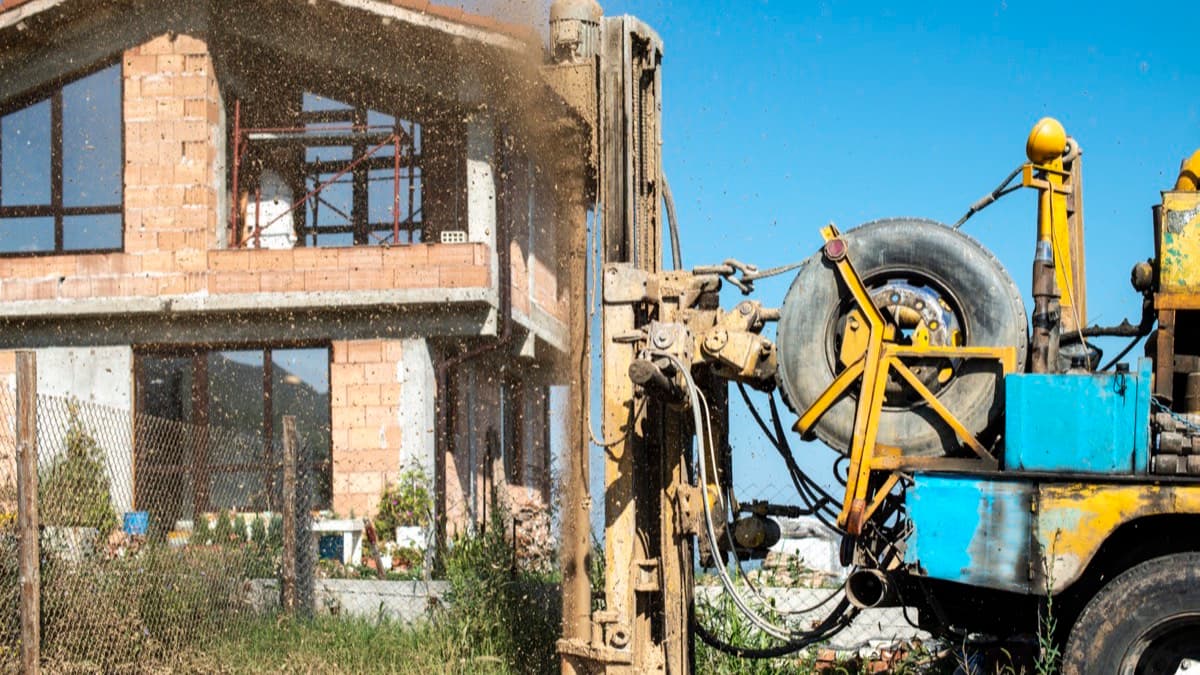
The loop can run horizontally in shallow trenches, vertically in deep holes, or in a pond. Which one fits depends on the site. To find out whether a house suits a geothermal heat pump, talk to a geothermal designer or a local professional engineer rather than an installer.
An annotated example
What to do next
If the house has a geothermal system, find out its loop type and when it was installed, and keep that with the home's records.
Learn the geothermal system in the house
- Note the geothermal system's loop type and install date
FAQ
How does a geothermal heat pump work?
It trades heat with the shallow ground, which stays at about 40°F to 70°F all year. It draws heat from the earth in winter and moves heat into it in summer.
Does a geothermal system cost more than an air-source heat pump?
Yes, to install, mostly because of the ground loop. The energy it saves often pays back the difference over time.
Sources
Checked October 20, 2026
- U.S. Department of Energy, Office of Geothermal. Geothermal heat pumps (2026)
- U.S. Department of Energy, Office of Geothermal. Geothermal FAQs (2026)
- U.S. Department of Energy, Office of Geothermal. What are geothermal heat pumps? (2026)
- U.S. Department of Energy, Building Science Education. HVAC: geothermal heat pumps (2026)
- U.S. Department of Energy, Energy Saver. Energy Saver guide: tips on saving money and energy at home (2022)
- HVAC
- Owner