Explainer
Heat and energy recovery ventilators explained
A heat or energy recovery ventilator brings fresh air into a tight house and uses the air going out to warm or cool it.
Satisfy+ Editorial · Published September 7, 2026 · 3 min read
At a glance
- What it does
- Swaps stale indoor air for fresh outdoor air
- Heat it recovers
- About 70% to 80%, for most ERVs
- HRV
- Passes along heat only
- ERV
- Passes along heat and some moisture
An energy-efficient house, new or old, needs whole-house mechanical ventilation to keep its indoor air healthy. A tight house saves energy, but without enough fresh outdoor air, moisture, dust, pollen and other contaminants build up indoors. There are four types of whole-house system: exhaust, supply, balanced and energy recovery. An energy recovery system ventilates the house while losing as little heat as it can.
How it works
A recovery ventilator has an incoming duct for outdoor air and an outgoing duct for stale air. It moves equal amounts each way, so the house is neither pressurized nor depressurized. The two streams cross in a heat exchanger without mixing. In winter, heat from the air going out warms the cold air coming in. In summer, the cooler air going out cools the warmer air coming in. One or more fans move the air, and controls run it. Most ERVs recover about 70% to 80% of the heat in the air leaving.
The fresh air can travel through the furnace or air handler's ducts, or through the ventilator's own ducts, which is the better setup.
HRV and ERV
- A heat recovery ventilator (HRV) passes along heat only.
- An energy recovery, or enthalpy recovery, ventilator (ERV) passes along heat and some water vapor, from the more humid air stream to the drier one. That keeps the humidity inside the house steadier.
The maker's specifications say which model suits which climate, and an ERV in a humid climate needs to be installed to the maker's directions.
Cost and trade-offs
A recovery ventilator spreads fresh air to many parts of the house without creating big pressure differences. It also costs more than other ventilation systems, needs more maintenance and regular filter changes, and can be hard to install and set up. How much energy it saves varies.
What a good installation has
- A ducted supply or return, or both, in each occupied room with a door
- Outdoor air filtered by a MERV 11 filter or better, placed where you can reach it
- Duct runs kept as short as possible
- Duct seams sealed with mastic or UL 181 tape, and ducts outside the insulated part of the house insulated to at least R-8
- The exhaust outlet at least 10 feet from any air intake, and a screen on the outdoor intake
- The airflow measured once it's installed, with the filter and screen care explained to you
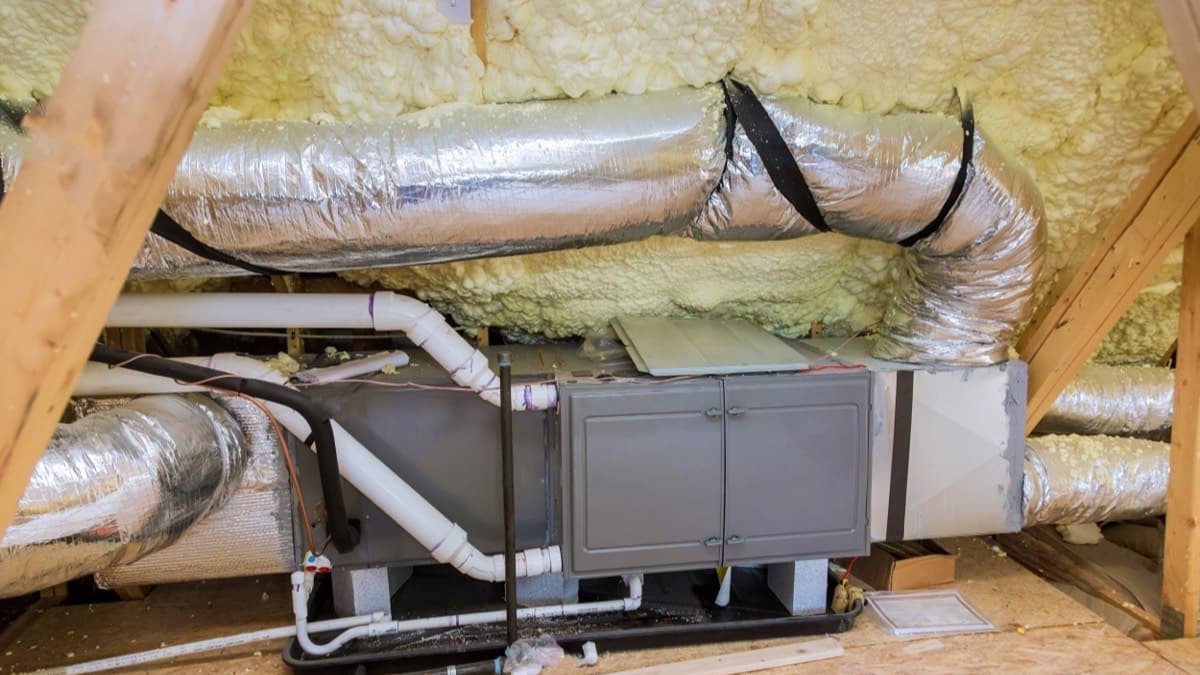
An annotated example
What to do next
If the house has an HRV or ERV, find out from the installer or the manual how often to change its filter and clean its intake screen.
Look after the recovery ventilator
- Replace the recovery ventilator's filter
- Clean the ventilator's outdoor intake screen
FAQ
What's the difference between an HRV and an ERV?
An HRV passes along heat only. An ERV passes along heat and some moisture, which keeps indoor humidity steadier.
How much energy does a recovery ventilator recover?
Most ERVs recover about 70% to 80% of the heat in the air leaving the house.
Does a recovery ventilator need maintenance?
Yes, more than other ventilation systems, including regular filter changes and a clean intake screen.
Sources
Checked October 20, 2026
- U.S. Department of Energy, Building Science Education. HVAC: energy recovery ventilation (2026)
- U.S. Department of Energy, Building Science Education. HVAC: whole-house ventilation (2026)
- U.S. Department of Energy, Building America Solution Center. Whole-house ventilation strategies for new homes (2026)
- U.S. Department of Energy, Building America Solution Center. Balanced HRV/ERV checklist (2026)
- HVAC
- Owner