Explainer
Solar water heaters explained
A solar water heater warms water in collectors, usually on the roof, and stores it in a tank, with a conventional heater as backup for cloudy days.
Satisfy+ Editorial · Published August 25, 2026 · 3 min read
At a glance
- Fuel
- Sunshine
- Hot water costs
- Cut by about half, for an ENERGY STAR system
- Active systems
- Electric pumps, valves and controllers
- Backup
- A conventional water heater, usually
A solar water heater, sometimes called a solar domestic hot water system, uses the sun's heat to warm water for the house. Each design has a collector and a storage tank. It works in any climate. An ENERGY STAR certified system can cut a household's yearly hot water costs about in half. On average, a home's water-heating electricity drops by at least half, and by more in a sunny place such as the Southwest.
A solar water heater suits a house that heats water with electricity, pays high electric rates and has an unshaded, south-facing spot such as a roof. The collector works best facing true south.
Active and passive systems
- Active systems use electric pumps, valves and controllers to move water from the collectors to the tank. They're the common kind in the United States.
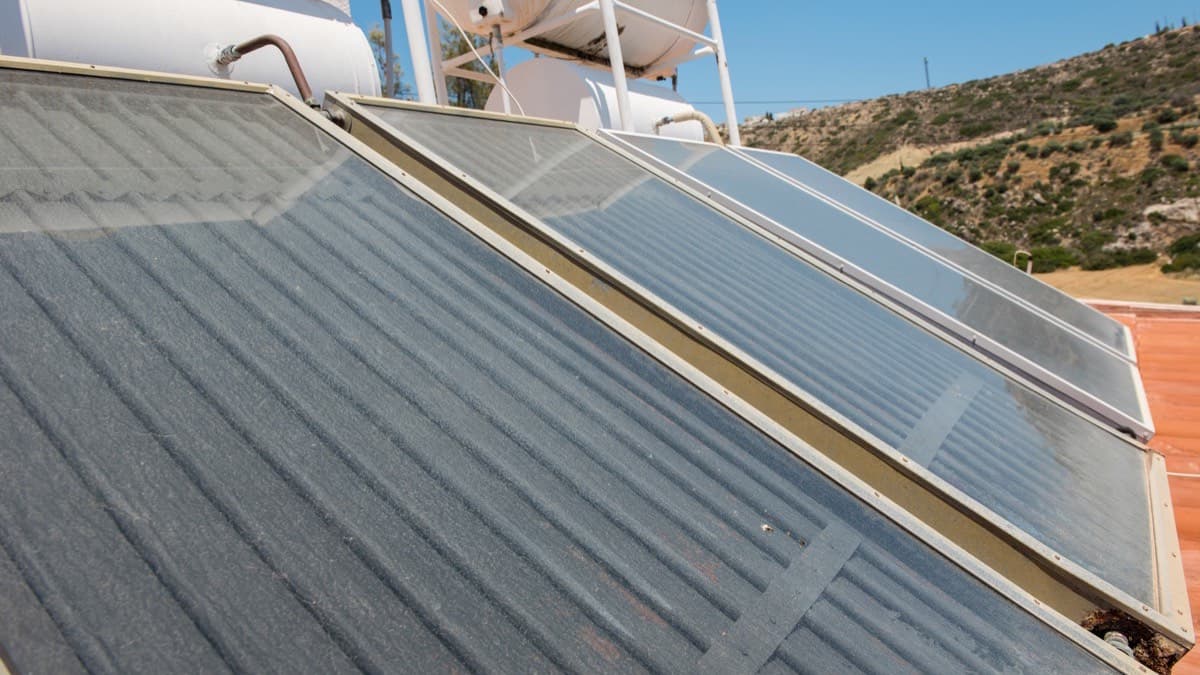
- Passive systems have no pumps. Natural convection moves the heated water from the collectors to the tank. A thermosiphon system is passive: water heated in a collector, usually on the roof, rises into the storage tank. These simple systems suit warmer coastal climates.
Direct and indirect circulation
- Direct systems run household water through the collectors. The heated water is stored in a tank, sent to a tankless water heater, or used straight away. They suit climates where it rarely freezes, and need freeze protection in cold ones.
- Indirect, or closed-loop, systems heat a fluid that won't freeze in the collectors. It passes through a heat exchanger in the tank, warms the water, and cycles back. They make sense where it freezes.
The collectors
- Batch collectors, also called integrated collector-storage, heat water in dark tanks or tubes inside an insulated box and hold it until it's drawn. When little hot water is used, the water can get very hot, so a tempering valve mixes in cold water to prevent scalding at the tap. They can't work with closed-loop systems, so they're generally not recommended for cold climates.
- Flat-plate collectors are copper tubes on flat absorber plates in an insulated box under tempered glass. One typically holds 40 gallons, and two supply roughly half the hot water a family of four needs.
- Evacuated-tube collectors are the most efficient. Each tube sits inside a larger glass tube with a vacuum between them, like a thermos. They work in overcast weather and down to -40°F, and a failed tube can be replaced on its own. They can cost twice as much per square foot as flat-plate collectors.
Backup and upkeep
A solar water heater usually works with an electric or gas backup water heater, which may come with the system. A system should be certified, and installed to local plumbing and building codes, with a roof mount that keeps water out of the roof. Look for the ENERGY STAR label, or certification by the Solar Rating and Certification Corporation or the Florida Solar Energy Center. A simple system may need servicing only every 3 to 5 years, preferably by a solar contractor.
An annotated example
What to do next
If the house has a solar water heater, find its owner's manual and set a reminder to have a solar contractor service it every 3 to 5 years.
Keep the solar water heater running
- Have a solar contractor service the solar water heater
- Find the solar water heater's owner's manual
FAQ
Do solar water heaters work in cold climates?
Yes. They work in any climate. Indirect systems, which circulate a fluid that won't freeze, make sense where it freezes.
Does a solar water heater need a backup?
Usually. It's generally designed to work with an electric or gas backup water heater.
How often does a solar water heater need maintenance?
A simple system may need servicing only every 3 to 5 years, preferably by a solar contractor.
Sources
Checked October 20, 2026
- U.S. Environmental Protection Agency, ENERGY STAR. Solar water heaters (2026)
- U.S. Environmental Protection Agency, ENERGY STAR. How it works: solar water heaters (2026)
- U.S. Department of Energy, Building Science Education. Water heaters: solar (2026)
- U.S. Department of Energy, Building Science Education. HVAC: thermosiphon solar water heaters (2026)
- U.S. Department of Energy, Energy Saver. Energy Saver guide: tips on saving money and energy at home (2022)
- Owner
- Water heater